Friday, July 03, 2009

Thursday, July 02, 2009
Monday, April 20, 2009
Nikhil Jayanti.
Today again after a year this blessed and most auspicious day has dawned.
Happy birthday to my Satgurunath Nikhileshwaranand.
He is no longer in the physical but as the song goes (i have modified it a bit)
waadiyan tera daaman raaste teri baahen
jaaoo tere siva main kahaa jaaonga
jab se milne lagi tumse raahe meri
chand suraj bani do nigahe meri
tum kahi bhi raho tum nazar aaoge
waadiyan tera daaman raaste teri bahen
jaaoo tere siva main kahaa jaaoonga.
Where else can i find refuge.
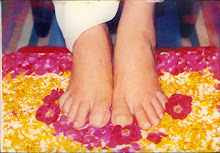
The lotus feet of my Stgurunath.
Happy birthday to my Satgurunath Nikhileshwaranand.
He is no longer in the physical but as the song goes (i have modified it a bit)
waadiyan tera daaman raaste teri baahen
jaaoo tere siva main kahaa jaaonga
jab se milne lagi tumse raahe meri
chand suraj bani do nigahe meri
tum kahi bhi raho tum nazar aaoge
waadiyan tera daaman raaste teri bahen
jaaoo tere siva main kahaa jaaoonga.
Where else can i find refuge.
The lotus feet of my Stgurunath.
Thursday, July 17, 2008
Guru Pournima.
Today happens to be Maharishi Veda Vyasa's Birthday and this day is celebrated as the Guru's day. This is the day when a disciple Tries to Thank the Guru for all the Guru has done for him.
I also take this opportunity to Thank all my Gurus -Past, Present and future. A Chela (Disciple, Shisya) can never ever repay the debt owed to the Guru and neither should he try to, because this indebtedness is something which binds or acts as a link between them and will keep the bond intact for eternity.
Shri Sadguru Nikhileshwaraanand Charan Kamalebhyo namah.
Shri Sadguru Achyutaanandaaya Charan Kamalebhyo Namah.
Vam VedaVyasaaya Namah.
Sri Sachidaanand paarmesthi Guru Saranam.
I also take this opportunity to Thank all my Gurus -Past, Present and future. A Chela (Disciple, Shisya) can never ever repay the debt owed to the Guru and neither should he try to, because this indebtedness is something which binds or acts as a link between them and will keep the bond intact for eternity.
Shri Sadguru Nikhileshwaraanand Charan Kamalebhyo namah.
Shri Sadguru Achyutaanandaaya Charan Kamalebhyo Namah.
Vam VedaVyasaaya Namah.
Sri Sachidaanand paarmesthi Guru Saranam.
Monday, April 21, 2008
Its Nikhil Jayanti.
Today is the most auspicious day for Nikhil devotees like me.
Happy birthday Sadgurudev.
Happy birthday Sadgurudev.
Saturday, October 20, 2007
The patron Deity of Palmistry.
See the following file to know about the patron deity of palmistry in India. Praying to her and doing her Sadhana will promote clairvoyance in you.
The document is in Hindi, if any questions are there post your comments and i will try to help.
The document is in Hindi, if any questions are there post your comments and i will try to help.
Friday, August 31, 2007
A Treat for Palmistry lovers.
he book written byWilliam Benham is considered to be the best book on the subject even after a century. any lover or newbie of this fascinating subject will profit if they go through the book.
For them i am posting a sample of the book.
this is the second part dealing with the lines. I have been able to post onl a few chapters of the same. a few pages are missing.
Hope all enjoy learning.
For them i am posting a sample of the book.
this is the second part dealing with the lines. I have been able to post onl a few chapters of the same. a few pages are missing.
Hope all enjoy learning.
Sunday, August 12, 2007
Friday, August 10, 2007
Sunday, July 29, 2007
Thank God for the Guru.

Today is the most auspicious day of Guru pournimaa (the full moon day when we thank the Guru for everything he/she has done for us).
I pay my heartfelt devotion and gratitude to all the teachers and master who touched my life and made it more wonderful.
A Guru is one who takes our fear (God) and fills us with Love (the self).
For a common person like me God was a personification of my fears (I worshipped a form as God only because I believed he will save me from all the bad things that happened to other peoples).
My Gurus showed me a path out of this delusion and brought me in the presence of the Truth.
My Satgurunath Dr. Narayandutt Shrimali who put the whole universe in my begging bowl.
Pundit Sanjay Rath (He has not accepted me as his student formally) not only for his Jyotish Knowledge but also for his humility and humaneness.
All the other Gurus who influenced me by their thoughts, words and deeds.
(There are toomany to be named individually).
Saturday, April 21, 2007
Nikhil Jayanti
Today is the Birthday of my Sadgurunath Nikhil.
It is the most auspicious date for us Nikhil Bhakts.
We all celebrate it in our different and unique ways.
I prefer a quiet celebration (mostly internal)
Happy Nikhil Jayanti to all.
It is the most auspicious date for us Nikhil Bhakts.
We all celebrate it in our different and unique ways.
I prefer a quiet celebration (mostly internal)
Happy Nikhil Jayanti to all.
Sunday, February 25, 2007
Complete Man
This post is a continuation from my previous post here
We have seen how the mind is made up of two distinct (from the personal viewpoint) compartments. First we have to understand that the mind itself was not created by the person but by the world.
The genetic code was a big contributing factor as also the time of conception and the state of mind
of the Parents during that time. Then, after birth the environment started to mould the raw material.
Many a slights and mishaps are forgotten by the conscious, but the sub-conscious is having a perfect record of it. Whenever a similar slight or mishap occurs again our reaction to it is always tinged by the memory Submerged in the Sub-conscious long forgotten by us. Then we wonder ‘why did I react like that?’
'The Complete Man' is the one who is aware of both his conscious as well as sub-conscious functioning (Of course a complete Woman Also).
In our scripture 'The complete Man' is personified in two distinct forms.
One form is of Ravana (the King of Lanka in the epic Ramayana) - He is shown as having ten heads (fully conscious personality).
The other is Lord Ganesh (Son of Parvati and Shiva). He has an elephants head. Ten human heads equals to one Elephant head.
Both these forms are complete but, with a difference.
Can you find out?
We have seen how the mind is made up of two distinct (from the personal viewpoint) compartments. First we have to understand that the mind itself was not created by the person but by the world.
The genetic code was a big contributing factor as also the time of conception and the state of mind
of the Parents during that time. Then, after birth the environment started to mould the raw material.
Many a slights and mishaps are forgotten by the conscious, but the sub-conscious is having a perfect record of it. Whenever a similar slight or mishap occurs again our reaction to it is always tinged by the memory Submerged in the Sub-conscious long forgotten by us. Then we wonder ‘why did I react like that?’
'The Complete Man' is the one who is aware of both his conscious as well as sub-conscious functioning (Of course a complete Woman Also).
In our scripture 'The complete Man' is personified in two distinct forms.
One form is of Ravana (the King of Lanka in the epic Ramayana) - He is shown as having ten heads (fully conscious personality).
The other is Lord Ganesh (Son of Parvati and Shiva). He has an elephants head. Ten human heads equals to one Elephant head.
Both these forms are complete but, with a difference.
Can you find out?
Friday, January 26, 2007
Monday, January 22, 2007
The Key to Success?
The five ‘S’ of Sadhana:
Sadhana means the effort put in to achieve a goal. Sadhak is the person trying to achieve the goal, Sadhya is the goal and when the goal is achieved through the Sadhaks effort it is called siddhi and the Sadhak is called a siddha (Adept) of that Sadhana.
This is applicable in any field of human endeavor but especially in the Spiritual path (Adhyatmik marg).
The Sadhya here is the Ishtaa devata (in the form of a mantra) and when the Sadhak achieves perfection in attuning the self towards the Devata (deity) to the extent that there is no differentiation between the self, the mantra and the devata.
The path of Sadhana is difficult but, if guidelines provided by the Siddhas who already achieved Siddhi of that particular Mantric form of the Deity, then success is more the easier.
In all Sadhanas five very important criteria has to be diligently fulfilled. These are called the five ‘S’ of Sadhana. They are:
1. Sthan : place – which means the place which you choose for doing a particular Sadhana cannot be changed in between.
2. Samaya: Time-which means you have to be very punctual in your Sadhana, and the time when you do your Sadhana cannot be changed every day. If for example you start the Sadhana at four o’clock in the morning then every day you have to start it at four in the morning, and flexibility of five minutes plus-minus is allowed not more than that.
3. Sankhya: Count- the number of repetitions (of the mantra) required each day should be fixed. You cannot increase or decrease it as per you whims. For example a particular Sadhana requires a minimum japa of hundred thousand (one Lakh) and you are doing the Sadhana for forty four days then divide the hundred thousand into forty four which comes to about two thousand seventy three per day or twenty three malas (one mala is one hundred and eight beads rosary). Every day you have to count so many rosaries –nothing less nothing more.
4. Samagri: Equipments and offerings- the offering prescribed for that particular Sadhana should be offered every day without fail, you are not allowed to skip or add some of your own. Also the equipments (like some Yantra, Mudras, Puja rituals, and any other special things like gutika etc) should be used every single day without skipping.
5. Samyama: Self Control- you have to control your natural urges for the whole period of Sadhana. Like celiblacy, dietary restrictions etc. Plus any special requirement as per the Sadhana procedure given through instruction from the Gurudev(Guru here means the revealer of the mantra as well as the procedure of Sadhana).
These are the very basis on which Sadhana is supported and which assures success.
I believe these qualities if inculcated in every day life for achieving the purpose of life (As per the persons aims and goals in life) then Siddhi (success) is sure and you will be called an expert of your chosen field.
Sadhana means the effort put in to achieve a goal. Sadhak is the person trying to achieve the goal, Sadhya is the goal and when the goal is achieved through the Sadhaks effort it is called siddhi and the Sadhak is called a siddha (Adept) of that Sadhana.
This is applicable in any field of human endeavor but especially in the Spiritual path (Adhyatmik marg).
The Sadhya here is the Ishtaa devata (in the form of a mantra) and when the Sadhak achieves perfection in attuning the self towards the Devata (deity) to the extent that there is no differentiation between the self, the mantra and the devata.
The path of Sadhana is difficult but, if guidelines provided by the Siddhas who already achieved Siddhi of that particular Mantric form of the Deity, then success is more the easier.
In all Sadhanas five very important criteria has to be diligently fulfilled. These are called the five ‘S’ of Sadhana. They are:
1. Sthan : place – which means the place which you choose for doing a particular Sadhana cannot be changed in between.
2. Samaya: Time-which means you have to be very punctual in your Sadhana, and the time when you do your Sadhana cannot be changed every day. If for example you start the Sadhana at four o’clock in the morning then every day you have to start it at four in the morning, and flexibility of five minutes plus-minus is allowed not more than that.
3. Sankhya: Count- the number of repetitions (of the mantra) required each day should be fixed. You cannot increase or decrease it as per you whims. For example a particular Sadhana requires a minimum japa of hundred thousand (one Lakh) and you are doing the Sadhana for forty four days then divide the hundred thousand into forty four which comes to about two thousand seventy three per day or twenty three malas (one mala is one hundred and eight beads rosary). Every day you have to count so many rosaries –nothing less nothing more.
4. Samagri: Equipments and offerings- the offering prescribed for that particular Sadhana should be offered every day without fail, you are not allowed to skip or add some of your own. Also the equipments (like some Yantra, Mudras, Puja rituals, and any other special things like gutika etc) should be used every single day without skipping.
5. Samyama: Self Control- you have to control your natural urges for the whole period of Sadhana. Like celiblacy, dietary restrictions etc. Plus any special requirement as per the Sadhana procedure given through instruction from the Gurudev(Guru here means the revealer of the mantra as well as the procedure of Sadhana).
These are the very basis on which Sadhana is supported and which assures success.
I believe these qualities if inculcated in every day life for achieving the purpose of life (As per the persons aims and goals in life) then Siddhi (success) is sure and you will be called an expert of your chosen field.
Thursday, January 11, 2007
Believe it or not.
In today’s world where people belonging to the same religious affiliation but different sect (what to speak of people of different religion) are killing each other without even blinking. There is precedence in history of a religious leader laying down his life for people belonging to different faith. Such a nobleand compassionate soul was the ninth Guru of the Sikhs. Read on….
The Ninth Master
Guru Tegh Bahadur (1621-1675)
Guru Tegh Bahadur was the youngest son of Guru Hargobind and Bibi Nanki and was born at Amritsar on April 1, 1621.
While the Guru attended to his devotees at Anandpur, things in the country were rapidly deteriorating under the tyrannous rule of emperor Aurengzeb. Since coming to power by imprisoning his father and killing his two brothers, Aurengzeb had been consolidating his power base. After ten years he now began to apply his power throughout the country. Aurengzeb was an orthodox Muslim who dreamed of purging India of all ‘infidels’ and converting it into a land of Islam. Aurengzeb had no tolerance for other religions and proceeded on a brutal campaign of repression. Famous Hindu temples throughout the country were demolished and mosques built in their place. Hindu idols were placed in the steps of mosques to be trodden on by the feet of Muslim pilgrims. Aurangzeb issued a number of harsh decrees. In 1665 he forbade Hindus to display illuminations at Diwali festivals. In 1668 he forbade Hindu Jatras, in 1671 he issued an order that only Muslims could be landlords of crown lands, and called upon provincial Viceroys to dismiss all Hindu clerks. In 1669 he issued a general order calling upon all governors of all provinces to destroy with a willing hand the schools and temples of the infidels; and they were told to put a stop to the teachings and practicing of idolatrous forms of worship. In 1674 lands held by Hindus in Gujarat, in religious grants were all confiscated.
In this climate of intolerance the viceroy of Kashmir Iftikhar Khan took to the task of forcibly converting the Hindu population to Islam by the sword. The Hindu Brahmin Pandits of Kashmir were among the most highly learned and orthodox of the Hindu leadership. Aurangzeb felt if they could be converted, the rest of the country would easily follow. He did not want to see the talik (holy mark on the forehead) or janaeu (sacred thread) on any of his subjects. Given this ultimatum, a large delegation of 500 Kashmiri Pandits decided to journey to Anandpur Sahib to seek the help of Guru Tegh Bahadur. This delegation was led by Pandit Kirpa Ram Datt (who would later on become the Sanskrit teacher of Guru Gobind Singh and eventually become a Khalsa and died fighting in the battle of Chamkaur). The Pandits met the Guru and explained their dire predicament to the Guru and requested the Guru to intercede on their behalf. As the Guru was pondering over the issue his nine year old son Gobind Rai walked into the room, noticing the serious and gloomy mood in the room the young Gobind asked his father what was happening. Guru Tegh Bahadur replied, “Unless a holy man lays down his head for the sake of the poor Brahmins, there is no hope for their escape from imperial tyranny.” Young Gobind replied, “Revered father, who would be better equipped for this than yourself?” Guru Tegh Bahadur hugged his son and wept for joy. “I was only worried about the future, for you are far too young”. “Leave me to God”, Gobind replied, “and accept the challenge of the Mughals.”
Even though Guru Nanak had refused to wear the sacred thread when he was young, the Gurus still believed in the freedom of religion and the right of the Hindus, Muslims and Sikhs to live in peace and practice their own religions. With this Guru Tegh Bahadur laid down the gauntlet in the fight for freedom of religion and told the Pandits to inform Aurangzeb that the Brahmins would gladly accept and embrace Islam if Guru Tegh Bahadur can be convinced to do so. Guru Tegh Bahadur made preparations to leave for Delhi. he bid farewell to his family and followers and dictated that his son Gobind Rai should be installed as the next Guru. Accompanying the Guru on his journey and also prepared to accept the consequences of whatever happened were Bhai Mati Das, Bhai Dyala and Bhai Sati Das. As soon as Aurangzeb heard the news he ordered the immediate arrest of the Guru. Guru Tegh Bahadur and his party were arrested soon after they left Anandpur Sahib and taken in chains to Delhi.
When brought before Aurangzeb, he was asked why he was hailed as the Guru or prophet and called ‘Sacha Padsah’ (the True King) and if he really believed in his being one he should perform a miracle to justify his claim. Guru Tegh Bahadur reprimanded the emperor for his blind orthodoxy and his persecution of other faiths, “Hinduism may not be my faith, and I may believe not in the supremacy of Veda or the Brahmins, nor in idol worship or caste or pilgrimages and other rituals, but I would fight for the right of all Hindus to live with honour and practice their faith according to their own rites.” The Guru answered further, “Every ruler of the world must pass away, but not the Word of God or His Saint. This is how people not only call me a True King but have done so through the two centuries before me in respect of my House and also in respect of others who preceded them and identified themselves not with the temporal and the contingent, but with the eternal and the ever dying.” The Guru refused to perform any miracles saying, “this is the work of charlatans and mountebanks to hoodwink the people. Men of God submit ever to the Will of God.” Guru Tegh Bahadur refused to embrace Islam, saying “For me, there is only one religion - of God - and whosoever belongs to it, be he a Hindu or a Muslim, him I own and he owns me. I neither convert others by force, nor submit to force, to change my faith.” Aurangzeb was enraged and ordered Guru Tegh Bahadur to be forced to convert to Islam through torture or be killed.
Guru Tegh Bahadur was subjected to many cruelties, he was kept in an iron cage and starved for many days. The Guru was made to watch as Bhai Mati Das the devoted Sikh was tied between two pillars and his body split in two by being sawn alive. Bhai Dyala was boiled alive in a cauldron of boiling water and Bhat Sati Das was wrapped in cotton wool and set on fire. The Guru bore these cruelties without flinching or showing any anger or distress. Finally on November 11, 1675 Guru Tegh Bahadur was publicly beheaded with the sword of the executioner as he prayed. The Gurus body was left in the dust as no one dared to pick up the body for fear of the emperors reprisal. A severe storm swept through the city and under the cover of darkness a Sikh named Bhai Jaita managed to collect the Guru’s sacred head and carried it off to Anandpur Sahib to the Guru’s son. Another Sikh Bhai Lakhi Shah who had a cart, was able to smuggle the Gurus headless body to his house. Since a public funeral would be too dangerous, Bhai Lakhi Shah cremated the body by setting his house on fire. Meanwhile the head was taken to the grief stricken young Guru Gobind Singh and the widow Mata Gujari. On November 16, 1675 at Anandpur Sahib, a pyre of sandalwood was constructed, sprinkled with roses and the head of Guru Tegh Bahadur was cremated by young Guru Gobind Singh.
Thus the earthly reign of the ninth Nanak, Guru Tegh Bahadur ended. Never in the annals of history has the religious leader of one religion sacrificed his life to save the freedom of another religion.
Believe it for it is True.
The Ninth Master
Guru Tegh Bahadur (1621-1675)
Guru Tegh Bahadur was the youngest son of Guru Hargobind and Bibi Nanki and was born at Amritsar on April 1, 1621.
While the Guru attended to his devotees at Anandpur, things in the country were rapidly deteriorating under the tyrannous rule of emperor Aurengzeb. Since coming to power by imprisoning his father and killing his two brothers, Aurengzeb had been consolidating his power base. After ten years he now began to apply his power throughout the country. Aurengzeb was an orthodox Muslim who dreamed of purging India of all ‘infidels’ and converting it into a land of Islam. Aurengzeb had no tolerance for other religions and proceeded on a brutal campaign of repression. Famous Hindu temples throughout the country were demolished and mosques built in their place. Hindu idols were placed in the steps of mosques to be trodden on by the feet of Muslim pilgrims. Aurangzeb issued a number of harsh decrees. In 1665 he forbade Hindus to display illuminations at Diwali festivals. In 1668 he forbade Hindu Jatras, in 1671 he issued an order that only Muslims could be landlords of crown lands, and called upon provincial Viceroys to dismiss all Hindu clerks. In 1669 he issued a general order calling upon all governors of all provinces to destroy with a willing hand the schools and temples of the infidels; and they were told to put a stop to the teachings and practicing of idolatrous forms of worship. In 1674 lands held by Hindus in Gujarat, in religious grants were all confiscated.
In this climate of intolerance the viceroy of Kashmir Iftikhar Khan took to the task of forcibly converting the Hindu population to Islam by the sword. The Hindu Brahmin Pandits of Kashmir were among the most highly learned and orthodox of the Hindu leadership. Aurangzeb felt if they could be converted, the rest of the country would easily follow. He did not want to see the talik (holy mark on the forehead) or janaeu (sacred thread) on any of his subjects. Given this ultimatum, a large delegation of 500 Kashmiri Pandits decided to journey to Anandpur Sahib to seek the help of Guru Tegh Bahadur. This delegation was led by Pandit Kirpa Ram Datt (who would later on become the Sanskrit teacher of Guru Gobind Singh and eventually become a Khalsa and died fighting in the battle of Chamkaur). The Pandits met the Guru and explained their dire predicament to the Guru and requested the Guru to intercede on their behalf. As the Guru was pondering over the issue his nine year old son Gobind Rai walked into the room, noticing the serious and gloomy mood in the room the young Gobind asked his father what was happening. Guru Tegh Bahadur replied, “Unless a holy man lays down his head for the sake of the poor Brahmins, there is no hope for their escape from imperial tyranny.” Young Gobind replied, “Revered father, who would be better equipped for this than yourself?” Guru Tegh Bahadur hugged his son and wept for joy. “I was only worried about the future, for you are far too young”. “Leave me to God”, Gobind replied, “and accept the challenge of the Mughals.”
Even though Guru Nanak had refused to wear the sacred thread when he was young, the Gurus still believed in the freedom of religion and the right of the Hindus, Muslims and Sikhs to live in peace and practice their own religions. With this Guru Tegh Bahadur laid down the gauntlet in the fight for freedom of religion and told the Pandits to inform Aurangzeb that the Brahmins would gladly accept and embrace Islam if Guru Tegh Bahadur can be convinced to do so. Guru Tegh Bahadur made preparations to leave for Delhi. he bid farewell to his family and followers and dictated that his son Gobind Rai should be installed as the next Guru. Accompanying the Guru on his journey and also prepared to accept the consequences of whatever happened were Bhai Mati Das, Bhai Dyala and Bhai Sati Das. As soon as Aurangzeb heard the news he ordered the immediate arrest of the Guru. Guru Tegh Bahadur and his party were arrested soon after they left Anandpur Sahib and taken in chains to Delhi.
When brought before Aurangzeb, he was asked why he was hailed as the Guru or prophet and called ‘Sacha Padsah’ (the True King) and if he really believed in his being one he should perform a miracle to justify his claim. Guru Tegh Bahadur reprimanded the emperor for his blind orthodoxy and his persecution of other faiths, “Hinduism may not be my faith, and I may believe not in the supremacy of Veda or the Brahmins, nor in idol worship or caste or pilgrimages and other rituals, but I would fight for the right of all Hindus to live with honour and practice their faith according to their own rites.” The Guru answered further, “Every ruler of the world must pass away, but not the Word of God or His Saint. This is how people not only call me a True King but have done so through the two centuries before me in respect of my House and also in respect of others who preceded them and identified themselves not with the temporal and the contingent, but with the eternal and the ever dying.” The Guru refused to perform any miracles saying, “this is the work of charlatans and mountebanks to hoodwink the people. Men of God submit ever to the Will of God.” Guru Tegh Bahadur refused to embrace Islam, saying “For me, there is only one religion - of God - and whosoever belongs to it, be he a Hindu or a Muslim, him I own and he owns me. I neither convert others by force, nor submit to force, to change my faith.” Aurangzeb was enraged and ordered Guru Tegh Bahadur to be forced to convert to Islam through torture or be killed.
Guru Tegh Bahadur was subjected to many cruelties, he was kept in an iron cage and starved for many days. The Guru was made to watch as Bhai Mati Das the devoted Sikh was tied between two pillars and his body split in two by being sawn alive. Bhai Dyala was boiled alive in a cauldron of boiling water and Bhat Sati Das was wrapped in cotton wool and set on fire. The Guru bore these cruelties without flinching or showing any anger or distress. Finally on November 11, 1675 Guru Tegh Bahadur was publicly beheaded with the sword of the executioner as he prayed. The Gurus body was left in the dust as no one dared to pick up the body for fear of the emperors reprisal. A severe storm swept through the city and under the cover of darkness a Sikh named Bhai Jaita managed to collect the Guru’s sacred head and carried it off to Anandpur Sahib to the Guru’s son. Another Sikh Bhai Lakhi Shah who had a cart, was able to smuggle the Gurus headless body to his house. Since a public funeral would be too dangerous, Bhai Lakhi Shah cremated the body by setting his house on fire. Meanwhile the head was taken to the grief stricken young Guru Gobind Singh and the widow Mata Gujari. On November 16, 1675 at Anandpur Sahib, a pyre of sandalwood was constructed, sprinkled with roses and the head of Guru Tegh Bahadur was cremated by young Guru Gobind Singh.
Thus the earthly reign of the ninth Nanak, Guru Tegh Bahadur ended. Never in the annals of history has the religious leader of one religion sacrificed his life to save the freedom of another religion.
Believe it for it is True.
Wednesday, January 03, 2007
What a cure or water cure?
Dharma of water :
The most essential requisite for our body is air. God himself has made arrangements for it. We breathe air even without our knowledge. Next comes water not food. This has to be supplied by us we have given a mistaken identity to food and brought food to second place. Since we violated the Dharma of water, we paved the way for diseases. The problems that arise out of the violation have to be rectified only by resorting to the dharma of water. Do you know that we can prevent 50% of diseases by just drinking plenty of water ? Yes, it is a bare truth.
In God’s creation itself, three-fourth of the universe is water and one fourth is land. In the same way there is 68% water and only 32% solid matter in our body.
Our outer body is cleansed of dirt when we bathe in water. The sameway if we supply sufficient quantity of water to the inner body every cell inside will have a thorough bath. A cleaning effect takes place inside our body.
It is an established fact that we should drink three times the quantity of water to the quantity of food we eat. That is the law of the body, that is the law of nature. On an average an adult takes 2 kgs of solid food. So he should drink nearly 5 to 6 litres of water. It’s not enough if you know how much to drink you should also know how and when to drink.
You should not drink while eating in fact it is harmful. Water dilutes the digestive juices, food remains long in the stomach and intestines and digestion becomes slow. For instance, when you grind dal for idli you add water only later. The same way you should drink water only after the food is digested completely.
How to drink water
a) Your blood and your body gets cleansed mostly by the water you drink early in the morning before breakfast. As soon as you get up, you can drink around a litre to litre and a half. You can do some exercise fifteen minutes after drinking water.
b) After exercise or after 45 to 60 minutes you should drink again the same quantity of water. The first dosage of water soaks all the waste material in water and the second dosage enables an outlet to it through urine.
You can have yet another dosage if you have a possibility. It will give a final wash to your internal body and purify your blood.
You can take solid food 20 minutes after drinking water.
c) You should again drink 3 glasses of water compulsorily half an hour before lunch.
d) After food don’t drink water for 2 hours. After that drink two glasses of water. Ever since then, till 15 minutes before taking another solid food, you can drink as much water as you can in installments.
e) Finally you should drink 3-4 glasses of water half an hour before dinner.
f) Two hours after food you should drink half to one glass of water.
Don’t entertain false notions like you urinate more, its not good for your kidneys and what not initially you may face some problems, but if you persist you can be cured of many of your minor but regular complaints like stomachache, ulcer, constipation etc. You can be cured very much faster this way than by taking medicines. Can’t you believe it? Try it for just ten days, whole heartedly and see for yourself.
The above write up was from here.
The most essential requisite for our body is air. God himself has made arrangements for it. We breathe air even without our knowledge. Next comes water not food. This has to be supplied by us we have given a mistaken identity to food and brought food to second place. Since we violated the Dharma of water, we paved the way for diseases. The problems that arise out of the violation have to be rectified only by resorting to the dharma of water. Do you know that we can prevent 50% of diseases by just drinking plenty of water ? Yes, it is a bare truth.
In God’s creation itself, three-fourth of the universe is water and one fourth is land. In the same way there is 68% water and only 32% solid matter in our body.
Our outer body is cleansed of dirt when we bathe in water. The sameway if we supply sufficient quantity of water to the inner body every cell inside will have a thorough bath. A cleaning effect takes place inside our body.
It is an established fact that we should drink three times the quantity of water to the quantity of food we eat. That is the law of the body, that is the law of nature. On an average an adult takes 2 kgs of solid food. So he should drink nearly 5 to 6 litres of water. It’s not enough if you know how much to drink you should also know how and when to drink.
You should not drink while eating in fact it is harmful. Water dilutes the digestive juices, food remains long in the stomach and intestines and digestion becomes slow. For instance, when you grind dal for idli you add water only later. The same way you should drink water only after the food is digested completely.
How to drink water
a) Your blood and your body gets cleansed mostly by the water you drink early in the morning before breakfast. As soon as you get up, you can drink around a litre to litre and a half. You can do some exercise fifteen minutes after drinking water.
b) After exercise or after 45 to 60 minutes you should drink again the same quantity of water. The first dosage of water soaks all the waste material in water and the second dosage enables an outlet to it through urine.
You can have yet another dosage if you have a possibility. It will give a final wash to your internal body and purify your blood.
You can take solid food 20 minutes after drinking water.
c) You should again drink 3 glasses of water compulsorily half an hour before lunch.
d) After food don’t drink water for 2 hours. After that drink two glasses of water. Ever since then, till 15 minutes before taking another solid food, you can drink as much water as you can in installments.
e) Finally you should drink 3-4 glasses of water half an hour before dinner.
f) Two hours after food you should drink half to one glass of water.
Don’t entertain false notions like you urinate more, its not good for your kidneys and what not initially you may face some problems, but if you persist you can be cured of many of your minor but regular complaints like stomachache, ulcer, constipation etc. You can be cured very much faster this way than by taking medicines. Can’t you believe it? Try it for just ten days, whole heartedly and see for yourself.
The above write up was from here.
Tuesday, December 19, 2006
Can one sell Geeta?
For the past many days ISKON people are selling Translation of Geeta by Srila Prabhupada in train stations of Mumbai. They are shouting as though they are selling some ware. The speaker blare loudly offering fifty percent discount on the Geeta.
It leaves a very bad taste in my mouth.
Firstly what they are selling is a translation with commentary (with the original verses) by somebody, how so ever he may be respectful, but they shout on top of their voice,"Geeta, fifty percent discount, discounted rate, buy now!"
What people of other religious affiliation may be thinking?
Is this the way we treat the Song of lord Krishna to Arjun, recorded by Lord Ganesh, dictated by Veda vyasa, described by Sanjay to Drithrastra and then commented upon by so many illustrious people starting from the Adi Shankara himself?
Can one sell the Geeta and that to at a discounted price?
It happens only in India.
It leaves a very bad taste in my mouth.
Firstly what they are selling is a translation with commentary (with the original verses) by somebody, how so ever he may be respectful, but they shout on top of their voice,"Geeta, fifty percent discount, discounted rate, buy now!"
What people of other religious affiliation may be thinking?
Is this the way we treat the Song of lord Krishna to Arjun, recorded by Lord Ganesh, dictated by Veda vyasa, described by Sanjay to Drithrastra and then commented upon by so many illustrious people starting from the Adi Shankara himself?
Can one sell the Geeta and that to at a discounted price?
It happens only in India.
Monday, December 18, 2006
Your seal on life or God's seal on you?
Indian palmistry – Samudrika shastra as it is called. There are very few books published on this in the English language.
Indian palmistry has many systems.
The major one is the Samudrik (purported to come from Samudra- Ocean) it may also mean Sa + Mudra i.e. with mudra. Mudras are special gestures made with the palm in Indian classical dances, during Pooja, mantra and Tantra sadhana and also in Yog sadhana. Mudra also means a seal.
So in a way your fate is sealed or you may leave your seal on life.
Like that song in Karma (Hindi movie).
The second is popular in Southern India called the Kartikeya system, named after the warrior son of Lord Shiva.
Then there is the third system followed by Nadi system.
Few of the books published on these different systems that I have come across dealing with the above systems are
1) Bhat’s treatise on Indian school of palmistry.
2) Samudrika Shastra by K.C.Sen (Taraporewala publications)
3) Sariraka shastra by Iyer (Taraporewala publication)
4) Shri R.G.Rao’s books on Nadi system.
The first book was published in 1938. It is a small book and I believe is out of print.
It was written by B. R. Bhat an advocate from Mumbai who was also an editor of the Coimbatore Times.
Samudrik Shastra gives much importance to the various auspicious figures found on the palm; Let me list a few of them.
Trident, wheel, elephant goad, Flag, Swastika, bow, umbrella, Sun, moon, houses, horse, elephant, mountains, lotus, chariot, sword, rosary, conch, fish, pot, arrow, serpent, scorpion, eye, ear ring, creeper, grain of barley, hand held mirror and many more.
People who study this for the first time are at a loss as to how to locate these in the palm, especially those who have studied the western palmistry books. Many are turned off by these description and hence do not take seriously these symbols (it doesn’t look scientific enough - whatever that means).
But there is a new type of palmistry introduced in the west by Judith Hipskind (google it) which is reading of the lines on the knuckles of fingers at the back of the hand (the nail side). She also talks of many such figures found therein and believe me this is latest type of Palmistry. So obviously our ancestors knew what they were talking and it is just that we don’t understand properly.
Indian palmistry has many systems.
The major one is the Samudrik (purported to come from Samudra- Ocean) it may also mean Sa + Mudra i.e. with mudra. Mudras are special gestures made with the palm in Indian classical dances, during Pooja, mantra and Tantra sadhana and also in Yog sadhana. Mudra also means a seal.
So in a way your fate is sealed or you may leave your seal on life.
Like that song in Karma (Hindi movie).
The second is popular in Southern India called the Kartikeya system, named after the warrior son of Lord Shiva.
Then there is the third system followed by Nadi system.
Few of the books published on these different systems that I have come across dealing with the above systems are
1) Bhat’s treatise on Indian school of palmistry.
2) Samudrika Shastra by K.C.Sen (Taraporewala publications)
3) Sariraka shastra by Iyer (Taraporewala publication)
4) Shri R.G.Rao’s books on Nadi system.
The first book was published in 1938. It is a small book and I believe is out of print.
It was written by B. R. Bhat an advocate from Mumbai who was also an editor of the Coimbatore Times.
Samudrik Shastra gives much importance to the various auspicious figures found on the palm; Let me list a few of them.
Trident, wheel, elephant goad, Flag, Swastika, bow, umbrella, Sun, moon, houses, horse, elephant, mountains, lotus, chariot, sword, rosary, conch, fish, pot, arrow, serpent, scorpion, eye, ear ring, creeper, grain of barley, hand held mirror and many more.
People who study this for the first time are at a loss as to how to locate these in the palm, especially those who have studied the western palmistry books. Many are turned off by these description and hence do not take seriously these symbols (it doesn’t look scientific enough - whatever that means).
But there is a new type of palmistry introduced in the west by Judith Hipskind (google it) which is reading of the lines on the knuckles of fingers at the back of the hand (the nail side). She also talks of many such figures found therein and believe me this is latest type of Palmistry. So obviously our ancestors knew what they were talking and it is just that we don’t understand properly.
Monday, December 04, 2006
Submerged in Air.
I wonder if the fishes and other aquatic creatures are aware of the water they are submerged in.
For them it will be very much like air is for us.
Even we don't give a second thought to the fact that we are submerged in air.
This air that we breath in and out and on which our life is dependent is shared by all air breathing animals plants and sundry.
In fact it connect us to everybody else not only from the present but also from the future.
When I inhale air iam infact inhaling the world and when i exhale i spread out into the world.
For them it will be very much like air is for us.
Even we don't give a second thought to the fact that we are submerged in air.
This air that we breath in and out and on which our life is dependent is shared by all air breathing animals plants and sundry.
In fact it connect us to everybody else not only from the present but also from the future.
When I inhale air iam infact inhaling the world and when i exhale i spread out into the world.
Thursday, November 30, 2006
Many dimensions.
Astrology can be seen or useful in many dimensional ways.
Let me try to make it clearer
One dimensional: this is your popular sun sign astrology, wherein all the population of this world is herded into twelve categories or zodiac signs. This is the most popular form and also the reason for criticisms directed towards Astrology by the so called informed elite.
Two dimensional: the form of astrology that casts a birth chart for the place time and date of birth for a person and tries to predict about the persons life. This is more personal and useful form of Astrology.
Three dimensional: This form is also like the two dimensional one but details of the person’s relatives and friend are also predicted. Predictions about parents, siblings, spouse?s , children( number and sex and there future) business partners etc.
Four dimensional: in addition to all that details of past generations (forefathers), past lives of the person himself is also dealt.
Multidimensional: prediction regarding the world, events which effect large body of people and nations, weather, earthquakes, market fluctuations etc.
During my study of Astrology i graduated form the first (Remember Linda Goodman's Sun sign) and now i am studying the third. In between i was studying a system of astrology developed by Manubhai Shah called the Shah's system of prediction which I will callas two dimensional.
Not many people are aware of this system. It is fairly simplistic and very easy to learn.
I will try to give more info on this system on future posts, I feel it needs to be more widely known and learnt as i believe it has almost disappeared after the demise of its progenitor.
Let me try to make it clearer
One dimensional: this is your popular sun sign astrology, wherein all the population of this world is herded into twelve categories or zodiac signs. This is the most popular form and also the reason for criticisms directed towards Astrology by the so called informed elite.
Two dimensional: the form of astrology that casts a birth chart for the place time and date of birth for a person and tries to predict about the persons life. This is more personal and useful form of Astrology.
Three dimensional: This form is also like the two dimensional one but details of the person’s relatives and friend are also predicted. Predictions about parents, siblings, spouse?s , children( number and sex and there future) business partners etc.
Four dimensional: in addition to all that details of past generations (forefathers), past lives of the person himself is also dealt.
Multidimensional: prediction regarding the world, events which effect large body of people and nations, weather, earthquakes, market fluctuations etc.
During my study of Astrology i graduated form the first (Remember Linda Goodman's Sun sign) and now i am studying the third. In between i was studying a system of astrology developed by Manubhai Shah called the Shah's system of prediction which I will callas two dimensional.
Not many people are aware of this system. It is fairly simplistic and very easy to learn.
I will try to give more info on this system on future posts, I feel it needs to be more widely known and learnt as i believe it has almost disappeared after the demise of its progenitor.
Subscribe to:
Posts (Atom)